Site.pro
  • AI Website Builder
    • AI Website Builder
    • Prices
    • Online Stores
    • Collaboration
    • Website Import
    • Plugins
    • Website Builder
    • Templates
    • For Design Studios
    • Useful Links
    • Affiliate Program
    • We Build for You
    • Examples
    • Languages
  • Domains
    • Register Domain Name
    • Migrate Domains
    • For Domain Investors
    • Domain Zones
    • Domainity
    • FAQ: Domains
    • Popular Domain Zones
    • .com
    • .org
    • .net
    • .us
    • .co
  • Email
    • Free Email
    • Transfer Emails
    • Email for Business
    • Prices
    • Custom Domain Email
    • FAQ: Email
    • Popular FAQs
    • Email Setup
    • Auto Reply
    • Auto Forwarding
    • Spam Protection
  • Accounting Software
    • Accounting Software
    • Modules
    • Prices
    • Integrations, API
    • Accounting Companies (385)
    • Software Integrators (52)
    • Affiliate Partners
    • Useful Links
    • Business Types
    • Use Cases
    • Accounting Companies
    • Sole Proprietor
    • Invoicing
    • Farmer
    • E-commerce
  • For Resellers
    • Prices
    • White Label
    • Revenue Share
    • Panels
    • How it Works
    • Marketing Materials
    • Mass Import
    • Our Partners
    • Reselling Examples
    • Documentation
    • Free Websites
  • Learn
    • Knowledge Base
    • Blog
    • Growth Hacking
    • For Hostings
    • For Education
    • Website Сreation Tutorial
    • Teaching Institutions (68)
    • Accounting Courses Worldwide
  • AI Website Builder
    • AI Website BuilderAI creates websites for you
    • PricesAdvanced Features
    • Online StoresBuild online stores
    • CollaborationCo-create websites live
    • Website ImportImport Any Website
    • PluginsBuilder plugin and functions
    • Website BuilderKey Features
    • Templates200+ Awesome Templates
    • For Design StudiosBenefits for Design Studios
    • Useful Links
    • Affiliate Program
    • We Build for You
    • Examples
    • Languages
  • Domains
    • Register Domain NameDomain registration, parking, transfer
    • Migrate DomainsTransfer. Connect. Renew
    • For Domain InvestorsDiscount on all domains
    • Domain ZonesBuy New Domain Name
    • DomainityDomain usage by country
    • FAQ: DomainsFind Answer
    • Popular Domain Zones
    • .com
    • .org
    • .net
    • .us
    • .co
  • Email
    • Free EmailCreate email
    • Transfer EmailsMigrate your mailboxes
    • Email for BusinessAdvanced features & protection
    • PricesCheap email hosting
    • Custom Domain EmailEmail address with your domain
    • FAQ: EmailFind Answer
    • Popular FAQs
    • Email Setup
    • Auto Reply
    • Auto Forwarding
    • Spam Protection
  • Accounting Software
    • Accounting SoftwareCloud based ERP
    • ModulesMain accounting software modules
    • Prices30 days free trial
    • Integrations, APIIntegration with external systems
    • Accounting Companies (385)Choose your partner for accounting
    • Software Integrators (52)Pick your integrations partner
    • Affiliate PartnersPartners and Affiliate program
    • Useful LinksCalculators and Calendars
    • Business TypesUse Cases
    • Use Cases
    • Accounting Companies
    • Sole Proprietor
    • Invoicing
    • Farmer
    • E-commerce
  • For ResellersWhite Label
    • PricesRevenue Share. White Label
    • White LabelCustomise Builder
    • Revenue ShareEarn 50% from each upgrade
    • PanelsOne product for all platforms
    • How it WorksCloud or On-Premises
    • Marketing MaterialsVideo. Mockups. Blocks
    • Mass Import
    • Our Partners
    • Reselling Examples
    • Documentation
    • Free Websites
  • Learn
    • Knowledge BaseFAQ, Tutorial, Video
    • BlogSite.pro Blog
    • Growth HackingBoost your sales
    • For HostingsTips on marketing
    • For EducationTraining. Tutorials
    • Website Сreation Tutorial
    • Teaching Institutions (68)
    • Accounting Courses Worldwide
  • Register
    Site.pro

    Create Your Account

    Get started — free and easy!

    Register

    By proceeding, you accept our Terms of Service and Privacy Policy
  • Log in
    Site.pro

    Welcome back!

    Access your work space

    Log in

    New user? Create account
    Forgot password?
  • $
  • English
  • Shared Hosting (18)
  • Hosting Tips (73)
  • Web Design (19)
  • Marketing (6)
  • Education (7)
  • eCommerce (5)
  • Cloud Accounting (1)

Table of Contents:

Category
Search

Table of Contents:

The End of WordPress Era

The End of WordPress Era

For more than a decade WordPress has been the default option for website building of any scale. Agencies recommended it, hosting companies and panels optimised for it. An entire submarket of themes and plugins grew around WordPress, giving jobs to thousands of people.

But the times are changing. And while WordPress remains the giant that holds at least 40% of the web together (depending on how you count), its position is shaky right now. When you take a quick look at charts and usage rates, the shift doesn’t seem very big. In every statistics paper you look at, WordPress will be dominant.

However, it’s not that simple. Despite the best efforts of advertisers and big tech, WordPress stopped growing.

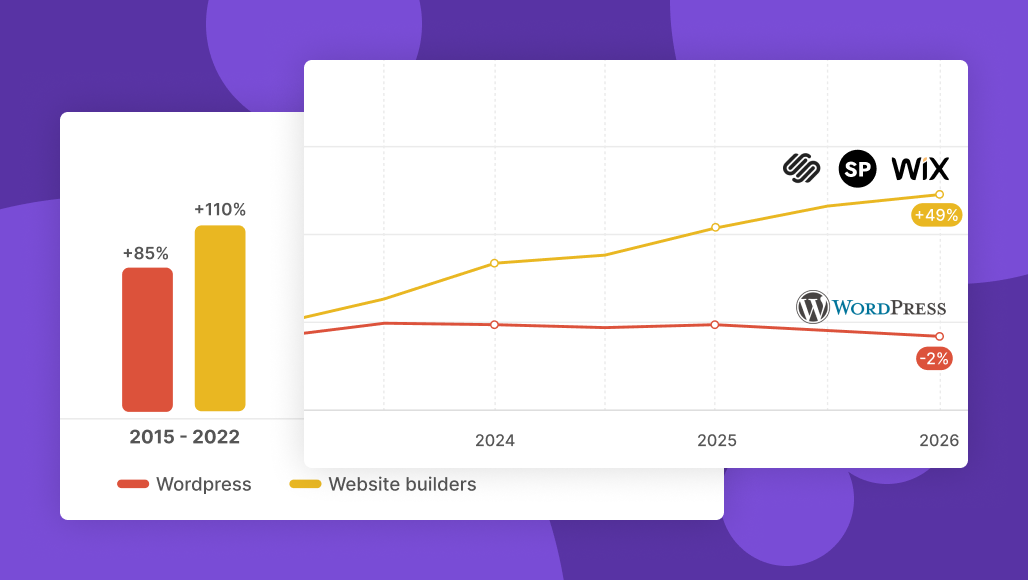
Growth percentage of WordPress vs website builders during 4 and 10 yearsGrowth percentage of WordPress vs website builders during the last 4 and 10 years. Source: W3Tech.

Usage Statistics: It’s Complicated

First things first, any discussion about WordPress market share starts with a confusion — how big is it, really? Some sources place it at around 60%, while others only show 40%. The difference comes from usage % and market share %.

For example, data from W3Techs consistently shows that WordPress accounts for roughly 60% of the CMS market — that's its market share. But it’s important to note that this number only counts websites that are built exactly with a content management system.

When measured on the scale of the entire web, including websites built from scratch, the WordPress share drops to around 40–45% — an actual usage rate. WordPress is only so big when compared to other CMS, on its own it’s much less prevalent.

Raw percentages in vacuum obscure real trends. Even if WordPress maintains its market share, the competitors don’t just stay and watch. Alternatives are growing.

CMS Usage Overall Market Share CMS
None 31,8 –
WordPress 43,3 62,7
Website Builders 12,3 17,8

Source: W3Tech. Updated 20.04.2026

Stability, or Stagnation?

At first glance, WordPress appears pretty stable. Its share remains at its usual percentage. And indeed, WordPress has been growing smoothly right until the beginning of 2020s.

Usage rate dynamics

Usage rate of custom code, WordPress and website builders from 2015 to 2026Usage rate of custom code, WordPress and website builders from 2015 to 2026. Source: W3Tech.

Historical trends show that WordPress reached its peak around 2022. But it hasn’t been growing ever since. It's position seems stable, but only if we look at overall usage rate, not growth rate. To get a more realistic idea on how big the growth or decline of WordPress is, we’ll make another chart to look at the actual growth dynamics.

Growth rate

Growth rate of custom code, WordPress, and website builders from 2015 to 2022Growth rate of custom code, WordPress, and website builders from 2015 to 2022. Source: W3Tech.

As we can see, WordPress growth rate has been getting higher from 2015 to 2022. But the overall growth of website builders is already bigger — 110% in 7 years. In 2022, a big shift started.

Growth rate of custom code, WordPress, and website builders from 2022 to 2026Growth rate of custom code, WordPress, and website builders from 2022 to 2026. Source: W3Tech.

While WordPress was slowing down, other solutions were taking full advantage of its downsides. As we can see, Site.pro, Wix, Shopify and other website builders have grown by 49% over the last 4 years, and by 200% over 10 years. These numbers are also supported by statistics from open sources: BuiltWith and Colorlib.

The actual growth of all website builders together outpaces WordPress considerably. WordPress and website builders met in 2022, and since then — the latter grew exponentially, while the former stopped improving. Recently, it WordPress started going down, which means its usage rate is also likely to start declining.

What Causes the Decline?

The decline of WordPress is actually predictable, despite it being free and open-source. It is the outcome of multiple gradual changes in website accessibility and the evolution of UX.

Too complicated

One of the most significant factors is the appeal of simplicity.

Website builders offer an environment where everything for website management is bundled together and practically billed all at once — a builder, hosting, security, sometimes domains and other systems, like email, e-commerce and CRM.

For users that aren’t into web design and programming, this removes the need to manage infrastructure or technical details.

Too Needy

Maintenance and security issues are the main bottleneck of WordPress websites. Running a WordPress website involves managing multiple plugins, backups and data protection. It gives freedom, but it also requires extra time and resources — people who run a small business often don’t have those.

The very ecosystem that made WordPress powerful—its big library of plugins and themes—also introduces complexity. Conflicts between extensions, performance slowdowns, and inconsistent quality can create friction, particularly for users without development experience.

National Institute of Standards and Technology warns that CMS that rely on plugin systems and third-party apps are more vulnerable to attacks and demand higher maintetance.

Too Slow

Performance expectations have also changed. While WordPress can achieve fast loading speeds, it often requires additional configuration. In contrast, most website builders offer optimised performance out of the box.

Security perception plays a role as well. WordPress’s popularity makes it a frequent target for attacks. Although the platform itself is not inherently insecure, poorly maintained installations contribute to a belief that it is less safe than managed alternatives.

Too Outdated

One of the biggest problems of WordPress is that the content ecosystem is changing. People no longer run blogs on their own websites like before.

Now, they heavily prioritise social media and video channels. This reduces the overall demand for WordPress.

Ending the Monopoly

Taken together, these trends point to a market that is becoming more diverse. WordPress is no longer the default choice for every type of user. Different tools are emerging for different needs.

  • For simple websites and small business pages, there are easy-to-manage AI website builders.
  • For e-commerce, platforms like Shopify offer an out-of-box solution for running an online store.

WordPress remains highly relevant, particularly for content-heavy sites, publishing platforms, and projects requiring flexibility. However, its role is shifting from universal solution to one option among many.

It's easy to see how AI website builders are conquering the Google search:

The popularity of AI website builder query on Google TrendsThe popularity of "AI website builder" query on Google Trends

The Future of WordPress

Will WordPress completely disappear? Unlikely. It still powers at least 40% of all websites globally. But its position is not what it used to be.

The era in which WordPress was the unquestioned default is coming to an end.

Future growth is likely to depend on how well the platform adapts to new expectations—simpler user experiences, better performance out of the box, and closer alignment with modern development practices.

At the same time, user behaviour is evolving. Search trends increasingly reflect interest in “AI website builders” and fully managed solutions, which shows that now users prefer convenience over control.

How to Hire a Web Designer: Rundown on WeWe, Fiverr and Upwork hiring
© Site.pro 2011. Website Builder. United States.
Contact SalesTerms of ServicePrivacy Policy