Site.pro
  • Creador de sitios web con IA
    • Creador de sitios web con IA
    • Precios
    • Tiendas en línea
    • Colaboración
    • Importación de sitios web
    • Complementos
    • Creador de Sitios Web
    • Plantillas
    • Para estudios de diseño
    • Idiomas
    • Programa de afiliados
    • Ejemplos
    • Para inversores de dominios
    • Nosotras construimos para ti
  • Dominios
  • Correo electrónico
  • Software de contabilidad
    • Software de contabilidad
    • Módulos
    • Precios
    • Integraciones, API
    • Empresas contables (366)
    • Integradores (48)
    • Socios afiliados
    • Enlaces útiles
    • Tipos de negocio
    • Empresas contables
    • Empresario individual
    • Facturación
    • Farmer
    • Comercio electrónico
  • Para Revendedores
    • Precios
    • Marca blanca
    • Compartir ingresos
    • Panel
    • Cómo funciona
    • Elementos de marketing
    • Importación masiva
    • Nuestros asociados
    • Ejemplos de reventa
    • Documentación
    • Sitios Web Gratis
  • Aprender
    • Base de Conocimientos
    • Tutoriales
    • Blog
    • Crecimiento Hacking
    • Para hosting
    • Dominio
    • Para educacion
    • Contabilidad: Inicio del trabajo
    • Instituciones educativas (68)
    • Cursos de contabilidad en todo el mundo
    • Curso en línea sobre contabilidad en EAU
  • Creador de sitios web con IA
    • Creador de sitios web con IALa IA crea sitios web para ti
    • PreciosCaracterísticas avanzadas
    • Tiendas en líneaCrea tiendas en línea
    • ColaboraciónTrabajen juntos en vivo
    • Importación de sitios webImportar cualquier sitio web
    • ComplementosPlugin y funciones
    • Creador de Sitios WebCaracterísticas clave
    • Plantillas200+ plantillas sorprendentes
    • Para estudios de diseñoBeneficios para los estudios de diseño
    • Idiomas
    • Programa de afiliados
    • Ejemplos
    • Para inversores de dominios
    • Nosotras construimos para ti
  • Dominios
  • Correo electrónico
  • Software de contabilidad
    • Software de contabilidadERP basado en la nube
    • MódulosMódulos principales contabilidad
    • Precios30 días de prueba gratuita
    • Integraciones, APIIntegración con sistemas externos
    • Empresas contables (366)Elija su socio para la contabilidad
    • Integradores (48)Elija su socio para integraciones
    • Socios afiliadosSocios y programa de afiliados
    • Enlaces útilesCalculators and Calendars
    • Tipos de negocioCasos de uso
    • Empresas contables
    • Empresario individual
    • Facturación
    • Farmer
    • Comercio electrónico
  • Para RevendedoresMarca blanca
    • PreciosCompartir ingresos. Marca blanca
    • Marca blancaPersonalizar creador
    • Compartir ingresosGana 50% por actualización
    • PanelProducto universal
    • Cómo funcionaEn la Nube o Local
    • Elementos de marketingVideo. Maquetas. Bloques
    • Importación masiva
    • Nuestros asociados
    • Ejemplos de reventa
    • Documentación
    • Sitios Web Gratis
  • Aprender
    • Base de ConocimientosPreguntas Frecuentes (FAQ): Creador, Contabilidad
    • TutorialesDescargar gratis
    • BlogSite.pro Blog
    • Crecimiento HackingAumenta tus ventas
    • Para hostingConsejos de marketing
    • DominioUso de dominios por país
    • Para educacionCapacitación. Tutoriales
    • Contabilidad: Inicio del trabajo
    • Instituciones educativas (68)
    • Cursos de contabilidad en todo el mundo
    • Curso en línea sobre contabilidad en EAU
  • Regístrese
    Al registrarse, usted acepta nuestros Términos de Servicio
  • Inicio de sesión

    Inicio de sesión

    Nuevo usuario? Crear cuenta
    ¿Olvidaste tu contraseña??
  • $
  • Español

In-house or Commercial: What Panel is the Best for Hosting Companies?

In-house or Commercial: What Panel is the Best for Hosting Companies?
Blog: Shared Hosting

In September 2025, Site.pro’s team took part in the Domain Summit in London. During the event, we shared experiences with Frederick Schiwek of Hosting.de, who gave valuable insights regarding web hosting panel development.

CEOs of both hosting companies and website builders face a difficult decision: whether to develop their own hosting panel or resort to commercial panels. The choice of a management system has a drastic impact on the business’s growth and on customer satisfaction.

Popular commercial solutions include panels such as WHMCS, Blesta, Hostbill, and Upmind. But what is better for the business: using one of the options mentioned above, or creating a custom solution?

In-house Panel: Pros and Cons

Advantages

Developing a custom panel gives hosting companies full control over its functions. The panel can be optimised for specific business processes, with no limitations imposed by third-party developers. Complete control also leads to high security—since all the data is processed and stored in-house, the team can immediately take action in case of an emergency and neutralise any security vulnerability on the spot. It is also easier to follow specific data protection regulations when your company is responsible for the product.

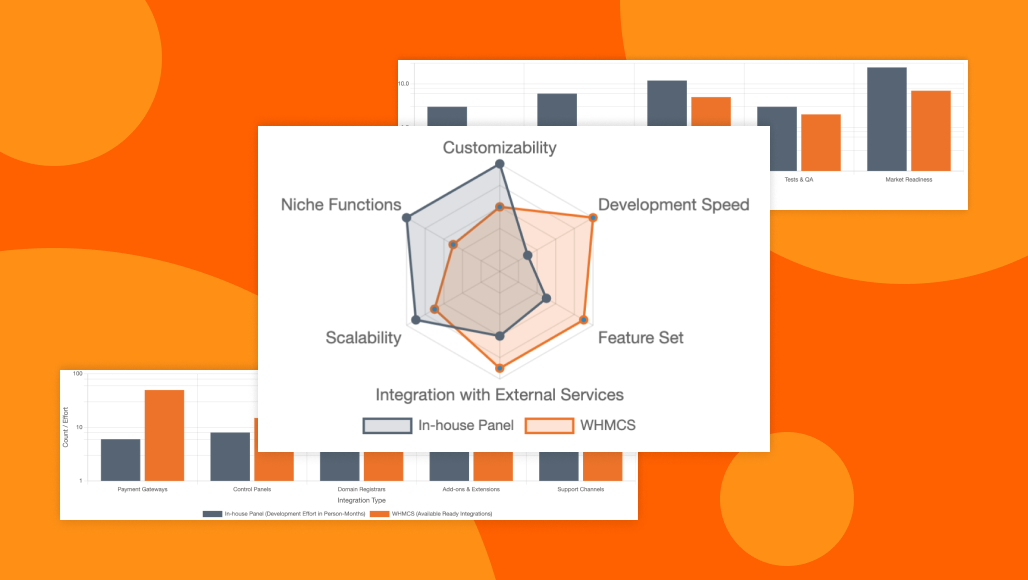
Flexibility and features comparison of two types of panelsFlexibility and features comparison of two types of panels

Moreover, developers can customise the panel however they want—setting up seamless connections to internal systems, including CRM, ERP, and customer support. The in-house panel also allows more room for future improvement.

As a product created by the hosting company itself, it does not come with any licence fees. Not only does this save money in the long term, it also allows the business to scale and grow more effectively, as in-house panels are not subject to licence restrictions. In this way, in-house panels become a competitive advantage for the business—a unique product optimised for the best customer experience.

Disadvantages

Still, in-house development has its own practical issues that need to be taken into consideration. The most obvious is the high cost that comes with developing a brand-new hosting panel. Creating a product from scratch requires significant investments in both time and resources. The process itself can take multiple years until the panel is finalised and ready for use. And even once it is finished, it requires proper maintenance and infrastructure. The responsibility for security, testing, and quality also lies on the shoulders of the development team.

Time comparison: in-house panels (months) vs. WHMCS (days)Time comparison: in-house panels (months) vs. WHMCS (days). Source: Frederick Schiwek's presentation for Domain Summit 2025

In-house vs Commercial Solution

Customisation Market entry Functionality Scalability Cost
In-house Unlimited Slow Need development High Unpredictable
Commercial Limited Fast Ready to use Low Predictable

Commercial SaaS panels are ready for installation and use upon purchase. The initial investment is low, and returns are quick. Costs are predictable from the start, with a monthly or annual licence fee based on the number of the company’s customers. This allows for fast market entry, as all core functions are available and configuration does not require programming.

Overall, domain and customer management are much easier on commercial panels, simply because these products have been in development for years. Much of their functionality has already been extensively tested, and their systems are mature and reliable. Commercial panels also often come with built-in billing from the start, whereas in-house development of such features is complex and expensive.

The Issue of In-house Development

The development of hosting panels in-house is complex, expensive, and carries significant risks. Aside from the panel itself, companies have to set up a support system, create and maintain documentation, and plan and test every feature of the product. When an important member of the team leaves, the product is affected. Meanwhile, commercial solutions have established communities, forums, and integrations with payment gateways, registrars, and more.

Ecosystem comparidson: development effort vs. available integrationsEcosystem comparidson: development effort vs. available integrations. Source: Frederick Schiwek's presentation for Domain Summit 2025

Should you Develop Your own Panel?

The short answer is yes—but there are nuances to consider. Your decision should be based first and foremost on the goals, budget, and resources of your company.

Key decision factors:

  • Company size and resources;
  • Specific requirements and niche market;
  • Growth plans;
  • Technical expertise of the team;
  • Development time.

Hosting.de Recommends

  • For startups — it is more reasonable to purchase a commercial solution for a quick launch, low risk, and cost-effectiveness.
  • For medium size or large companies — it makes sense to develop your own product when your requirements are specific and you are prepared to invest substantial resources into development. A hybrid approach also works—it is possible to buy a commercial panel as a base for future customisations.
  • Niche providers with special needs — if your goal is to provide customers with custom solutions and unique services, the in-house panel is the best option, as standard commercial panels cannot cover everything.

Final Thoughts

Choosing between an in-house panel and a commercial solution is ultimately a strategic decision that depends on a company’s size, resources, and long-term goals. Commercial panels offer speed, affordability, and reliability, while in-house solutions can prove to be a worthwhile investment with a competitive advantage over other options.

There is no one-size-fits-all answer—what matters most is aligning the choice of hosting panel with your business objectives, technical capabilities, and vision for the future.

Previo
How to Increase Traffic and Hosting Sales With AI Website Builder
Próximo
Boost Your Sales: White Label vs Revenue Share
© Site.pro 2011. Creador de Sitios Web. Estados Unidos.
Contactar con VentasTérminos de servicioPolítica de privacidad